




Research on the high energetic cost of color change in octopuses, conducted by Kirt Onthank, Walla Walla University professor of biology, and Sofie Sonner, WWU graduate, has been published in one of the world’s most prestigious and cited scientific journals, Proceedings of the National Academy of Sciences.
Onthank’s and Sonner’s findings have sparked interest in the scientific community, and within hours of the initial PNAS publication, Popular Science and ScienceAlert also published stories about the research.
Sonner, partnered with Onthank on this research as part of her master’s in biology thesis at WWU. Color-changing camouflage in octopuses requires exceptionally high metabolic costs, according to the study. Sonner and Onthank estimated the metabolic demand associated with color-changing chromatophore organs in ruby octopuses (Octopus rubescens).
The results, released in an article titled “High Energetic Cost of Color Change in Octopuses” in PNAS on Nov. 18, 2024, suggested that the energy required to simultaneously activate all a ruby octopus’s chromatophores was almost as high as the resting metabolic rate associated with all other physiological processes. “Though octopuses make color change look effortless, it isn’t for them,” said Onthank. The high energetic costs associated with the chromatophore system would likely put pressure on octopuses to minimize such costs, potentially contributing to the use of dens or nocturnal lifestyles in some octopus species and reductions in chromatophore systems among deep-sea species.
Onthank, a graduate of WWU himself, has long been fascinated by cephalopods and has published numerous peer-reviewed articles on octopuses’ energy budgeting, burrowing activity of octopuses, eye lenses of squid and a deep-sea octopus species, and the impacts of ocean acidification on octopus physiology. He was featured as an octopus expert for NBC National News (starting at timestamp 1:24) in April 2024.
Undergraduate and master’s students at WWU are invited to join Onthank in his research if they are interested. Much of this research is conducted at WWU’s Rosario Beach Marine Laboratory, located near Anacortes, Washington. “I typically have an octopus or two in my lab during the school year that students work with, and I generally have many octopuses at Rosario during the summer that students get to work with and study,” he said.
Immediately adjacent to Deception Pass State Park in the northwest corner of Washington state, Rosario Beach Marine Laboratory is a powerhouse biological research center. There, students have participated in important research on harmful algae blooms and detecting their presence quickly, seagrass wasting disease, oxygen consumption of nudibranchs and the development of motion-detecting underwater cameras, as well as hibernation and organ regeneration in sea cucumbers.
Intentional collaboration between professors, students and academic departments, makes exciting discoveries like this possible. In recent years, students from WWU’s Edward F. Cross School of Engineering have contributed to serious biological research. “Our engineers collaborate with marine biologists to develop tools for ocean research and exploration. This is essential for cutting-edge marine biology.”
Cutting-edge research like this not only contributes to the scientific community, but it helps to train student scientists interested in a variety of professions. The university’s Department of Biological Sciences offers undergraduate degrees in biology, biochemistry, bioengineering, biophysics and marine biology. In addition, WWU is the only private university in the Pacific Northwest to offer a master’s degree in biology.


The small dots visible around the octopus eye are chromatophores that allow it to change color.
Credit: Meg Mindlin
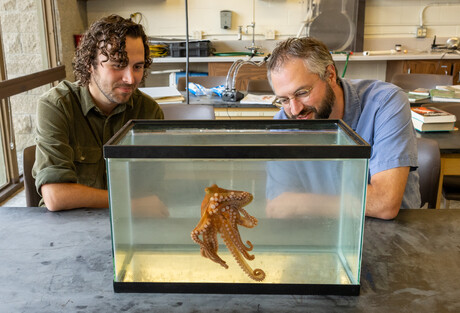
Kirt Onthank, right, observes an octopus at the Rosario Beach Marine Laboratory where high-level biological research is conducted in a Christian environment.
Credit: Chris Drake

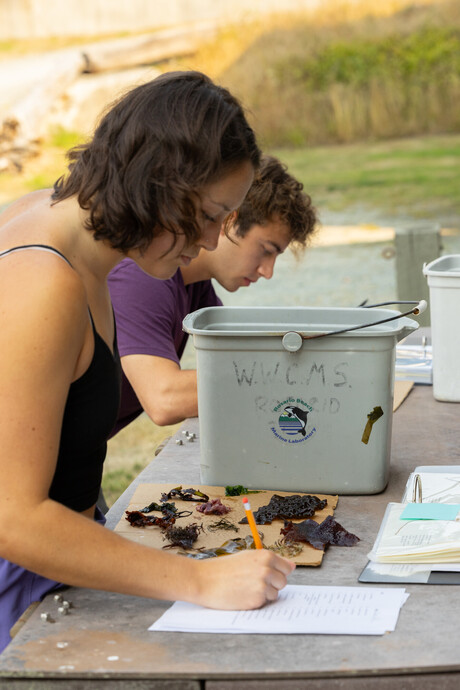
Students at Walla Walla University participate in hands-on research at Rosario, contributing to the scientific community and training to succeed in a variety of professions.
Credit: Chris Drake
Rosario Beach Marine Laboratory has been owned and operated by WWU since 1954 and exists primarily for the training of undergraduate and graduate students in marine, field and experimental sciences in a Christian setting. Nearly 3,000 students have studied and conducted research at Rosario Beach Marine Laboratory, which includes more than 40 acres of timberland, hills, wetlands and beachfront on the beautiful Rosario Strait. Rosario Beach borders the Salish Sea ecosystem including tide pools, mudflats, rocky shorelines, sandy beaches and deep water. These varied environments provide excellent training for students.
Onthank is a WWU professor of biology and specializes in cephalopod research. He received a bachelor’s and master’s degree in biology from WWU and earned a doctorate from Washington State University. He is known for his informational videos on TikTok, using the handle @theoctopusguy. He is also an active presenter with WWU’s Speakers Bureau.